

In this white paper, we outline how Rubicon Carbon brings confidence, scale, and innovation to the voluntary carbon market (VCM). Through our unique offering, we seek to drive climate action by making it easier and safer to include carbon credits in companies’ climate and sustainability goals.
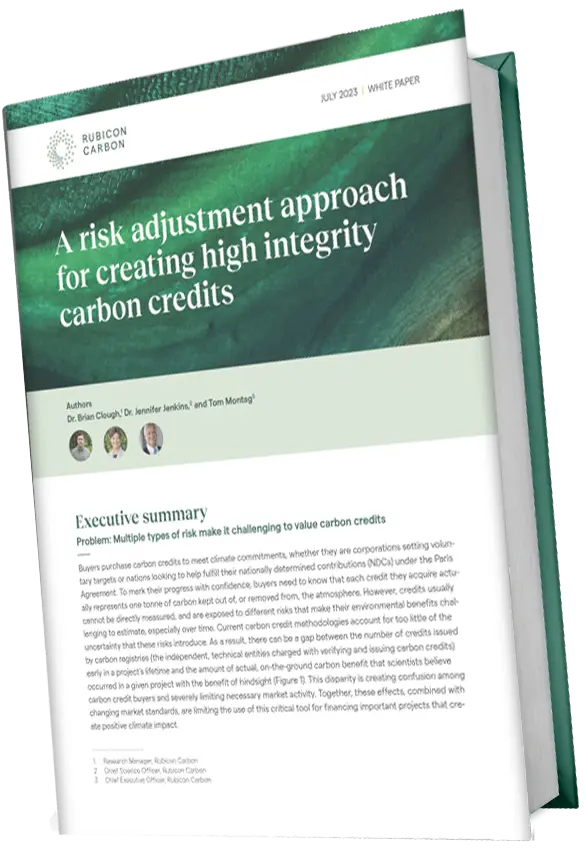
At Rubicon Carbon we’re committed to bringing integrity and credibility to the voluntary carbon market. Learn more about our revolutionary, risk adjusted method to carbon portfolio management.
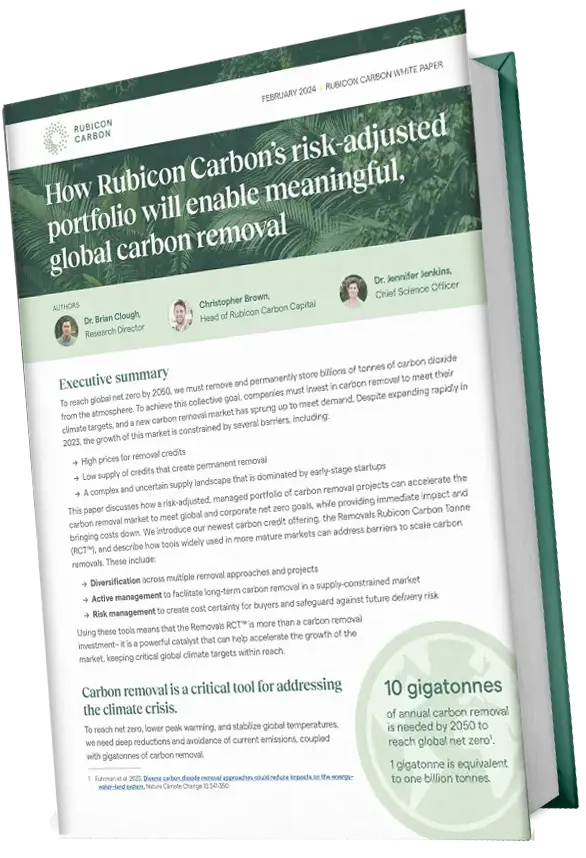
The planet has a challenge: to meet our global net-zero goal by 2050, we must remove approximately 10 gigatonnes of carbon dioxide equivalent from the atmosphere. This paper discusses how our portfolio approach can play a key role in unlocking catalytic finance for scalable climate solutions.
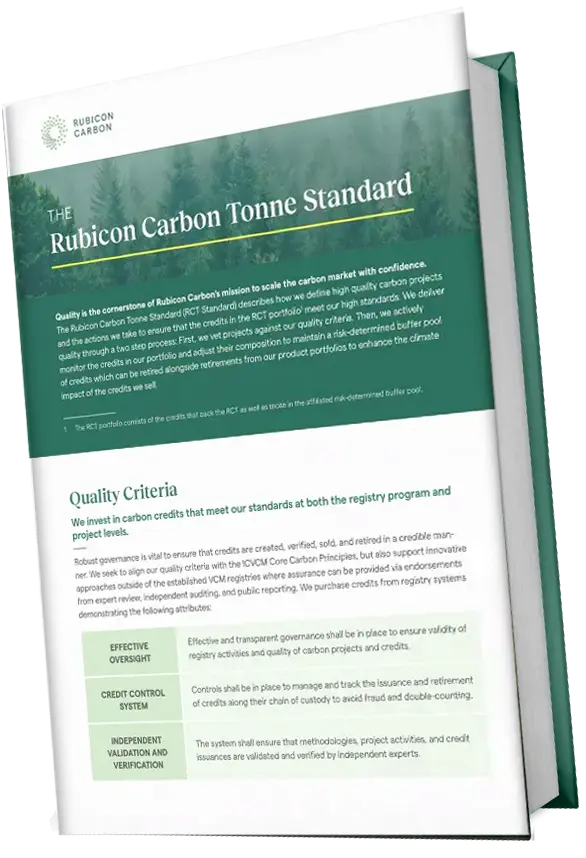
The Rubicon Carbon Integrity Framework defines the criteria and process Rubicon Carbon employs to evaluate and grade quality in carbon avoidance and removal projects. In this friendly user guide, we detail how we structure project evaluation, what project attributes we evaluate and how we monitor projects over time to update our risk calculations.
Rubicon Carbon is a carbon credit management firm that partners with the world’s largest enterprises to help them achieve their sustainability goals while driving global decarbonization. Backed by TPG Rise Climate and led by top executives from across finance, technology, and climate science, Rubicon Carbon delivers innovative carbon credit solutions to global businesses while unlocking decarbonization projects at scale, all backed by rigorous in-house scientific diligence.
We bring enterprise-grade solutions to the Voluntary Carbon Market that are built off of proven financial tools, helping to de-risk and scale investment. We prioritize:
We offer the following products:
• The Rubicon Carbon Tonne (RCT):
Diversified portfolio of carbon credits designed to reduce risk and increase optionality for ambitious corporate buyers. Rubicon Carbon currently offers curated RCTs containing carbon removal, nature-based avoidance, and super pollutant elimination credits.
• Build-your-own-portfolio:
Allows clients to tailor their portfolio of carbon credits to the specific needs and goals of their sustainability programs.
• Rubicon Rated Tonne (RRT):
A curated portfolio for customers seeking credits with third-party verification. The first of these portfolios has received an AAport rating by BeZero Carbon, a leading independent carbon ratings agency.
Currently, we are focused on corporate entities in need of meeting their climate commitments.
Our diligence process is comprised of three stages:
Stage 1 – RCT® Standard Assessment:
We complete an in-depth review of all project materials, relying on registry documents as well as information gathered from project developers and other market participants.
Stage 2 – Detailed Due Diligence:
Designated for early-stage projects that follow legacy methodologies, we evaluate the developer’s reputation, project’s registry election, commercial and operational risks, and community engagement before agreeing to an offtake. In some instances, we may recommend adjustments to key assumptions such as tree mortality rates or LCA system boundaries.
Stage 3 – Commercial and Long-Term Review:
Before making a capital investment in project development at the earliest stages of a planned project, we engage directly and exhaustively with the project developer to apply our technical and commercial expertise to guide and evaluate the project development process. We review a project’s carbon model assumptions for its suitability to the project area and activities, compare the project’s model to academic literature to evaluate the suitability of selected default values, and ensure that the monitoring plan for the life of the project meets the criteria for reducing the risk of undetected reversal (where relevant). We often recommend additional project changes to increase quality, rigor, and enhanced transparency in ongoing reporting.
Carbon credits are critical to help companies and society reach climate and sustainability goals. There is no current plan to reach our planetary 2050 net-zero goal that doesn’t include some corporate use of the carbon market. This is for three reasons: